

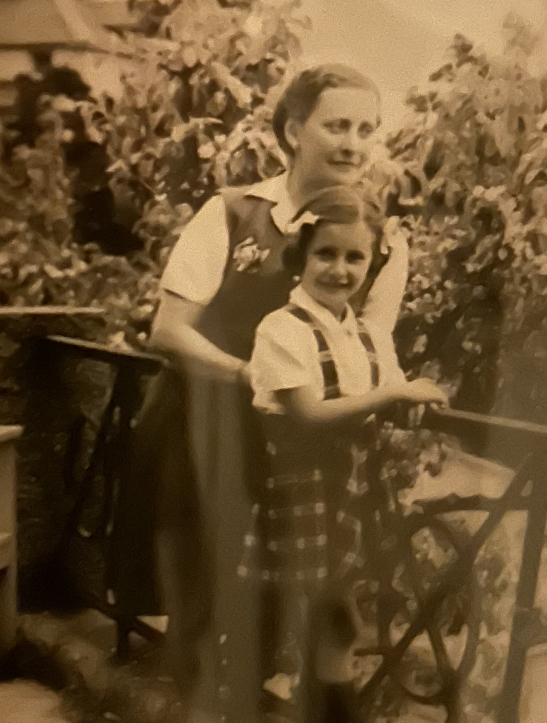
I don’t remember anyone sitting me down to tell me that my mother and grandparents were Holocaust survivors. It feels like I just always knew.
My grandfather was a physician drafted into the Polish army and spent the war years in Russia. My great-grandmother arranged fake papers that disguised my mother and grandmother as Catholic. With those papers, they spent several years hidden in plain sight with a righteous gentile family in a small village outside Krakow, Poland.
My grandmother prided herself on having spared my mother from the real horrors of the war. She was not taken to a concentration camp, did not have to hide like Anne Frank, and had a bed to sleep in and food to eat. Although my mother has a memory of a battle being fought outside the house where they were living and Nazis making visits to check people’s papers, my mom felt that her experiences during the war were easier than those of others.
Growing up, I wanted to learn about the Holocaust. I read historical fiction and classics like The Diary of Anne Frank and Elie Wiesel’s Night. I watched TV mini-series and movies. Whenever my family talked about the war, which wasn’t often, we talked about the Holocaust as my grandparents’ war.
So maybe it’s not surprising that my identity as a child of a survivor did not come into focus until the end of high school. When my gym teacher told me about an organization for children of survivors (2Gs), my mom decided to attend a meeting. I went because I was curious and wanted to keep my mom company. After all, we thought she was a 2G. At that meeting, we realized we had our labels wrong. My mother was not a 2G. She was a child survivor. I was the 2G. That moment reframed our understanding of how the war impacted our family and heightened my own sense of responsibility.
With this new perspective, I wanted to learn more. In college, I took a course on Holocaust history. As an adult, I went on a UJA mission to Eastern Europe. While the trip did not include time in Poland, I made sure to visit Auschwitz and Krakow, where my mother was born. I even got to meet the children of the family that saved my mother and grandmother.
By the time I had children of my own, I thought I knew so much about the different facets of the war, its horrors, and its aftermath. Given my family history, I didn’t think there was much more for me to learn. I had read the books, studied the history, and heard the stories firsthand.
It wasn’t until I started my work at Federation six years ago, on a grant supporting Holocaust survivors, that I realized how wrong I was. I still had a lot to learn, especially about the lives and needs of Holocaust survivors today.
Until then, I had always associated Holocaust survivors with Eastern Europe. But through this work, I learned that many survivors came from the former Soviet Union (FSU), including Jews born there as well as those who fled to the region to escape the Nazis. These survivors endured their own unique horrors. Most survivors alive today were children during the Holocaust, and many are from the FSU.
I learned that every survivor’s experience is unique. Trauma affects everyone in different ways, and it does not necessarily fade with time. In fact, it can become more difficult to manage as people age.
Most recently, I was saddened to learn that the Conference on Jewish Material Claims Against Germany (Claims Conference) projects that by 2040, 90 percent of all survivors will be gone. That means in just 15 years, we may have no survivors left to sit at our Passover seders, to share their stories and legacies, or to attend Holocaust remembrance services.
Even more disheartening is the fact that approximately 33 percent of survivors in the United States live at or below the poverty line. Globally, 40 percent of Holocaust survivors face financial distress. The Claims Conference estimates there are 220,800 survivors living in 90 countries. In our own community, Jewish Family Service of Central NJ and Jewish Family Service of MetroWest together serve more than 350 Holocaust survivors, many of whom live at or below the poverty line. This is happening right here.
So today, we are faced with demographic information that may be both surprising and deeply troubling. While the number of Holocaust survivors is declining, the needs of those still with us are growing. Like my own mother, they are aging and becoming more frail. They need more care and support.
As Giden Taylor, President of the Claims Conference, wrote: “Now is the time to double down on our attention on this waning population. Now is when they need us most.”
As a community, we must continue to care for these matriarchs and patriarchs of our Jewish family. We must appreciate that although the numbers of survivors may be shrinking, the needs are not. Through the Holocaust Survivor Fund, Jewish Federation of Greater MetroWest NJ provides critical funding to ensure that survivors live with dignity and security. They deserve nothing less. You can donate to the fund here.