
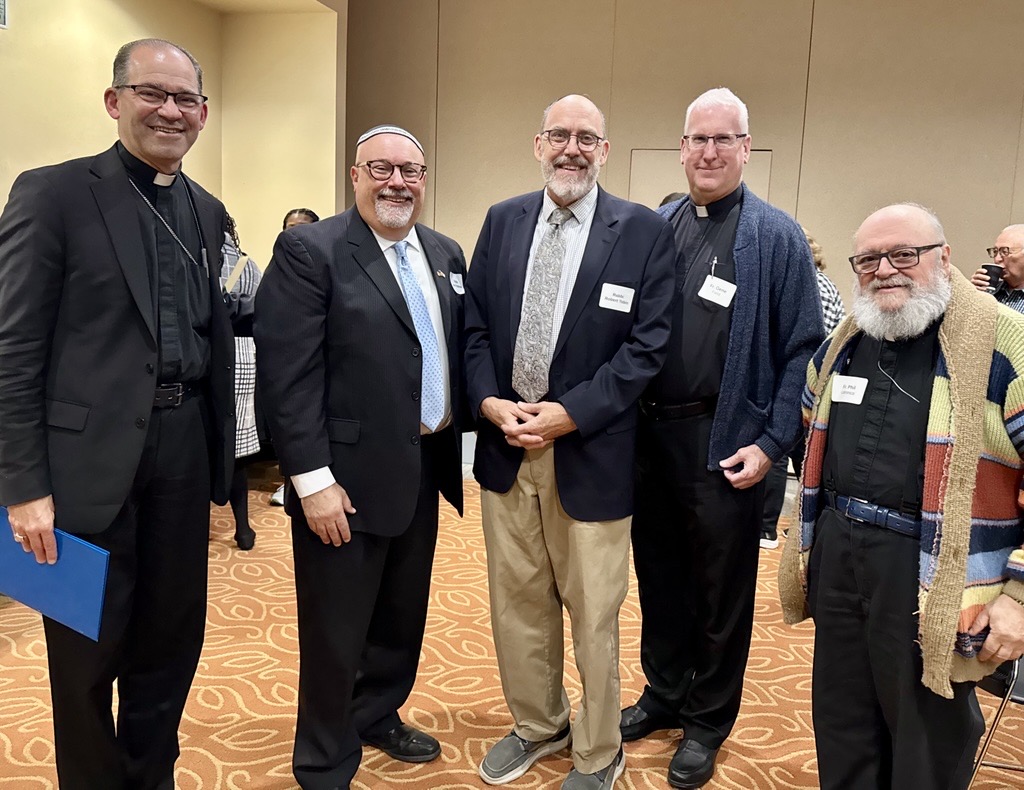
On October 21, Jewish Federation of Greater MetroWest NJ and the Archdiocese of Newark co-hosted an interfaith screening and discussion of the film Intelligent Lives. The event brought together Jewish and Catholic communities in a powerful evening of reflection, dialogue, and shared purpose, honoring the dignity and gifts of people with disabilities.
The film, narrated by Academy Award-winning actor Chris Cooper, follows three young adults—Micah, Naieer, and Naomi—who challenge outdated notions of intelligence and inclusion. Through their stories, Intelligent Lives invites viewers to reconsider how society measures worth, potential and belonging. The evening began with remarks from Rabbi Avi Friedman of Congregation Ohr Shalom and Bishop Michael Saporito of the Archdiocese of Newark. Both faith leaders reflected not only on the film’s message but also on their personal connections to the themes of disability, community and the sacredness of every life.
Faith in Action: The Meaning of “Accompaniment”
Bishop Saporito opened the evening with a reflection on a central theme of the Catholic Church’s Jubilee of Hope: accompaniment.
“In the Catholic world, we use that word a lot. We talk about journeying together in life and faith. But making accompaniment a reality takes more than words; it takes effort, presence, and love.”
He noted that the stories in Intelligent Lives embody this ideal not in theory but in practice. “The success of the dreams we see tonight comes because people and communities came together—not from afar, but personally—to make accompaniment real. None of this can happen unless we intentionally build bridges and come together,” he continued.
Rabbi Friedman: A Blessing for Difference
Rabbi Avi Friedman brought his own moving perspective to the conversation, shaped by his experience as the father of a 25-year-old son with Down syndrome.
He reminded the audience that the Talmud teaches us that when one encounters someone with a visible difference or challenge, they should recite a blessing: “Praised are You, Adonai, our God, who makes creatures different.”
He explained: “In composing this beautiful blessing, the ancient rabbis were teaching us that disabilities are not mistakes or aberrations. They are a blessed part of the beautiful world that God has gifted us.”
Rabbi Friedman illustrated this lesson through a personal story about teaching his son Jonah to ride a bike, a task they assumed, without hesitation, he could master. Only later did they learn that fewer than 10 percent of people with Down syndrome can typically do so due to balance challenges. “Because we didn’t know it was ‘impossible,’” he said with a smile, “Jonah just learned to ride.”
That simple act of faith and persistence became a metaphor for the evening’s message: When we assume possibility instead of limitation, extraordinary things happen, not just for individuals with disabilities, but for the communities that embrace them.
Rethinking What Makes Us “Intelligent”
The film’s opening narration by actor Chris Cooper struck a chord with many in the audience. Cooper recalled how a neurologist once told him that his son, who had cerebral palsy, would “never be intellectually normal.” Yet his son went on to become a straight-A student and poet.
Rabbi Friedman shared how this story resonated with his own family’s experience. When his son was tested by a school psychologist as a young child, one of the test images showed a McDonald’s sign, something Jonah, who keeps kosher, had never seen. “I don’t know what they were testing,” Rabbi Friedman said wryly, “but it certainly wasn’t his intelligence.”
He continued, “My son may not do calculus or conjugate verbs perfectly, but his social intelligence is off the charts. He remembers every person’s name in our congregation and their families, their joys, their struggles. That is intelligence, too.”
Quoting a rabbinic teaching from Pirkei Avot, Rabbi Friedman concluded: “Judge all people with the scale weighted in their favor.” For too long, he said, people with disabilities have been judged the opposite way. “As Catholics and Jews, or anyone of faith, we can all agree that they deserve better, and we deserve better. Because when we dismiss their intelligence, we deny ourselves the blessings their lives bring into the world.”
A Legacy of Friendship and Shared Hope
The interfaith gathering also carried historical resonance. It took place during the 60th anniversary of Nostra Aetate, the landmark Vatican II document that transformed Catholic–Jewish relations and called for a new era of understanding.
Six decades later, that spirit was vividly present in the shared purpose of this event. More than 50 attendees joined a post-film discussion on how faith communities can lead in rethinking ability, embracing neurodiversity and fostering equity for all. The more than 50 participants even wrote their own action commitments, adding them as “leaves” to a communal tree as a symbol of growth and inclusion.
As the audience left the screening, the sense of unity was palpable. In a world often divided by difference, this evening affirmed that hope grows strongest when communities come together to honor every person’s inherent dignity. “Intelligent Lives reminds us to celebrate our loved ones and their amazing abilities as they are, instead of mourning some version of them that never existed,” Rabbi Friedman said. In that celebration, the Jewish and Catholic communities found true common ground.