

In May, we celebrate Jewish American Heritage Month, a time to recognize and honor the rich contributions of Jewish Americans to our nation’s history, culture, and civic life. The accompanying photos offer just a small glimpse into the extensive holdings of the Jewish Historical Society of Greater MetroWest, whose archives preserve countless stories, artifacts, and memories that reflect the depth and diversity of Jewish life in our region. Each item represents not only a moment in time, but also the people, traditions, and values that have helped shape the community across generations.
Selecting just a few pieces to highlight is no easy task. How do we begin to choose from such a wealth of material that captures so many achievements and cultural milestones? For this feature, we focused on a few meaningful examples that reflect both community building and cultural impact: the history and growth of the JCC of Central New Jersey, the leadership and legacy of Carrie Bamberger Fuld, and the enduring culinary tradition of Cohen’s Knishes. Together, these stories offer a snapshot of the spirit, resilience, and creativity that define Jewish life in Greater MetroWest.
JCC of Central NJ

The Jewish Community Centers (JCCs) in Plainfield, Westfield, and Scotch Plains have played a vital role in supporting and shaping the Jewish community in Union County, New Jersey, with roots tracing back to 19th-century immigration. As Jewish immigrants, particularly from Eastern Europe, settled in the region, they established early institutions such as the Hebrew Benevolent Society, Jewish Family Service, and synagogues including Congregations B’nai Yisroel and B’nai Israel. By the late 1800s, agricultural communities and local organizations helped strengthen communal ties. In Plainfield, rapid growth between 1900 and 1918 saw the Jewish population expand significantly, supporting multiple congregations. Inspired by the establishment of the YMHA of Elizabeth, NJ, in 1906, seven young men founded the YMHA in Plainfield, which quickly grew into a vibrant community hub, eventually establishing a permanent home on West Seventh Street in 1930 and expanding further in 1955.
By the 1970s, new suburban growth shifted the community’s center of gravity, leading to the founding of the Greater Westfield YM-YWHA in 1974, which rapidly expanded its membership and programming. As populations moved out of Plainfield, leaders sought to unify efforts and establish a central location, eventually forming the JCC of Central New Jersey. Programming continued in both Plainfield and Westfield until the Plainfield facility closed in 1986. A major turning point came when the JCC acquired a former elementary school in Scotch Plains in 1987 after overcoming zoning and community challenges. In the 1990s, a major capital campaign and the leadership of Joseph Wilf and his family transformed the site into the Wilf Community Campus, featuring expanded facilities including multipurpose spaces, a gym, and a pool. What began as modest community initiatives evolved into a modern, comprehensive center serving people of all ages.
Carrie Bamberger Fuld
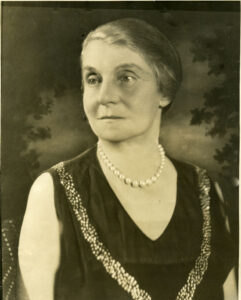
Carrie Bamberger Fuld was a visionary philanthropist whose generosity left a lasting mark on both Newark and beyond. Together with her brother, Louis Bamberger, and her husband, Felix Fuld, she helped establish the Institute for Advanced Study in Princeton, New Jersey—an institution that would become a global center for intellectual discovery. The Fuld family also supported numerous major institutions, including Newark Beth Israel Hospital, the Newark Museum of Art, and the Newark Public Library. Carrie, the sister of department store founder and philanthropist Louis Bamberger, was deeply committed to strengthening her local community.
Among her many contributions, she donated land and a home for the Jewish Day Nursery School, an initiative of Temple B’nai Jeshurun that opened in the early 1900s and continues today as the Fuld Neighborhood House. Perhaps her most visible and enduring legacy is her gift of 2,000 cherry blossom trees to the Essex County Commission. Many of these trees still bloom in Branch Brook Park, where about 40 of the original trees remain, offering a living tribute to her impact on Newark’s cultural and natural landscape.
Cohen’s Knishes

Cohen’s Knishes holds a special place in the food memories of Newark’s Jewish community, alongside beloved spots like Kiel’s Bakery, Dublin’s, and Henry’s Fish Market along Hawthorne Avenue. These neighborhood institutions are often fondly remembered in newsletters, online forums, and conversations about old Newark. Yet for many, Pearl Cohen Kasoff’s knishes stand apart. Those who tasted them often echo the same sentiment: “If you know, you know,” a simple phrase that captures just how memorable—and delicious—Cohen’s knishes were. Their flaky crust and savory fillings became synonymous with comfort food and community tradition.
What began as a local favorite soon grew into something much larger. Pearl Cohen Kasoff expanded her business significantly, opening the first U.S. government-inspected plant for kosher frozen foods. This innovation allowed Cohen’s to reach far beyond Newark, with additional retail locations in Irvington, Livingston, and West Orange. By 1983, Cohen’s Famous had become a major food company, with its products distributed in supermarkets nationwide. Today, the Cohen’s brand continues that legacy, with its knishes and other kosher foods still available in stores across the country, connecting new generations to a taste of Newark’s rich culinary past.
Honoring Jewish American Heritage Month and Celebrating 250 Years of America
We pay tribute to the generations of Jewish Americans who have helped form the fabric of American history, culture, and society. As we celebrate the 250th anniversary of our nation’s founding, we honor their enduring contributions and reaffirm the shared ideals of freedom, opportunity, and community that continue to shape the American story.