
As tensions continue between the United States, Iran, and Israel, our hearts are heavy. Lives have been lost. Families are grieving. Communities across Israel continue to live under the threat of rocket fire, their days shaped by uncertainty and resilience in equal measure.
And yet, even in moments like this, we are reminded why our partnership matters so deeply.
Sometimes, the most meaningful thing we can do is pause, not to escape reality, but to remember what connection, investment, and shared purpose can create over time. To hold onto moments of light. To reflect on joy, growth, and the relationships that sustain us when the world feels unsteady.
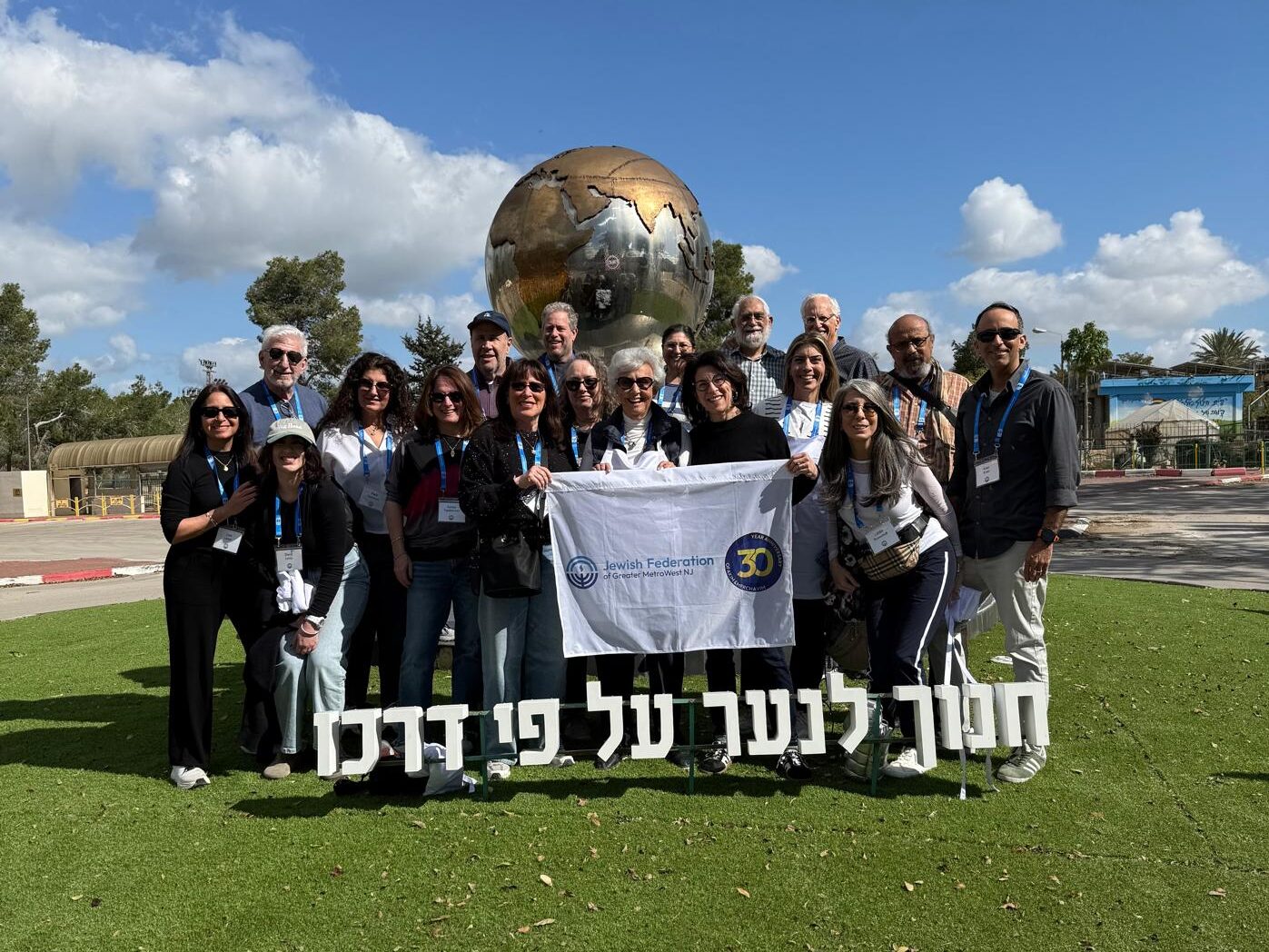
In late February, I led a cohort from Jewish Federation of Greater MetroWest NJ to Israel to mark a powerful milestone: 30 years of partnership with Ofakim and the Merchavim region, a relationship deeply rooted in mutual responsibility, the act of showing up and the commitment to building a future together.
What we experienced in just a few days reflected decades of partnership, friendship and commitment.
Chazak, chazak v’nitchazek! – Be strong, be strong, and may we be strengthened!
David Lentz
“Back to the future.” That’s what keeps playing in my mind.
Thirty years ago, when we first rolled into Ofakim, the town felt downcast. The textile factory had closed, unemployment was high, and Rechov Hertzl—the main entrance into the city—felt like a road leading nowhere in particular. There was even a leftover sign marking a former overseas partnership that had ended, leaving the city without outside support. It really felt that way.
In October, we arrived again, our little band of idealists who have spent countless hours trying to support Ofakim’s social welfare, then building something deeper through Living Bridge and the Peoplehood Project. Rechov Hertzl is still there. But everything else has changed.
Neighborhoods with homes and lawns. Expansive parks. A magnificent shopping center. A first-class Matnas filled with art, culture, and activity. The Negev Now project transforming older neighborhoods. There is a spirit and excitement that feels like Herzl’s dream of an old-new land renewing itself.
The moment that stayed with me most was standing outside the old Turkish police station at Mitzpe Patish, looking out over hills where thousands of new apartments are being built, where families will soon live, learn, and build community. It felt like we had come from the past and were looking clearly into the future—a future we helped create, even if only in a small but meaningful way.
That’s why I can’t stop thinking: we went back to the future.
Lisa Lisser
Thirty years of partnership. Thirty years of people.
Thirty years ago, the horizon looked bleak. Factories had closed. The fountain in the town square stood dry. Young people were leaving. But a small group from Greater MetroWest saw possibility and chose belief over limitation.
Ten years later, we marched through Ofakim and the fields of Merchavim, celebrating anniversary and renewal. Hundreds of schoolchildren walked alongside students from Greater MetroWest NJ’s Golda Och Academy. A panorama of laughter and joy walking together. Seeds were planted. Not just of projects, but of people.
That shift was called a “revolution” by our Israeli leaders. We stopped investing only in programs and started investing in one another.
Peoplehood Projects. Cycling clubs. Police Officer Exchanges. Shared learning. Friendships. Jewish identity as the connecting link.
This visit wasn’t just about honoring the past. It was about witnessing transformation. We drove through new neighborhoods rising alongside the original city. Parks. Social service centers. Plans to revitalize Kibbutz Galuyot, the oldest and most fragile neighborhood, with new housing and open space through the expertise of Manof, the social urban development nonprofit.
We stood overlooking a future high-rise district projected to bring 80,000 new residents. A bus will loop between old city and new, stitching history to possibility. Agro-tech is emerging as an economic engine. At Hagiva Elementary School, some of us made artificial caviar in the science lab—innovation grown in southern soil.
The horizon has widened.
And then the clouds. Forty eight people murdered in Ofakim on October 7. We met Ravit Illuz and learned about her husband Igal, a Peoplehood participant, police officer, and hero who ran toward danger. Grief and resilience live side by side here.
We learned about Noa Price, a young soldier of Nahal Oz, a daughter of our Peoplehood Project, who was murdered that Black Shabbat. A teacher exchange was created in her memory, Noa L’Olam. Educators who insist on connecting so that Noa’s joy for life will live on.
And still, life insists on being lived. Art. Music. Community. Creativity. The horizon has widened.
Michael Belfer
Each time I think I can’t enjoy visiting our partnership cities more than I already have, Israel continues to amaze me.
The trip began with an impromptu meeting with the parents of Noa Price. I spent an hour one-on-one with them, an experience that’s hard to put into words.
I was deeply moved meeting the educators who are part of the first Israeli cohort of this program and hearing their excitement about being included. It reaffirmed how important it is that this work continues and expands.
And then there’s New Ofakim. I am still talking about the 50 construction cranes in the sky.
One of the most special moments was dinner at the Kimchi home, where I reunited with many members of my Peoplehood 6 cohort. Spending time together, there and throughout the trip, confirmed just how meaningful and lasting these relationships are. Peoplehood works because it’s real.
Ilyssa Tepperman
I was so grateful to be part of this trip. This July marks ten years of my involvement with Federation, and seeing the impact of that work firsthand was incredibly meaningful.
I was asked to share an “aha” moment. Truthfully, the entire experience was one.
Seeing how much growth and transformation has taken place and understanding what “used to be” compared to what is now, was awe-inspiring. What began as partnership has truly become mishpacha.
Everywhere we went in Ofakim, there was growth—new neighborhoods, a new art center, the future resilience center. Meeting Ravit Illuz and hearing about her husband Igal, who was murdered on October 7 and was part of the Peoplehood Project, was deeply moving. His legacy is now part of my own Peoplehood journey.
Each day built on the last. From learning science with students, to art projects, to hearing about urban renewal and volunteer programs, it all reinforced one thing: what we have is not just partnership. It’s a shared vision for a beautiful future.
Rebecca Fisher
I am still in awe of the jampacked, colorful, meaningful days we shared together.
I learned so much about Ofakim’s past, its future, and what our next 30 years of partnership can look like. From planting trees with children, to learning science in a state-of-the-art lab, to singing, dancing, and sharing meals in people’s homes. These moments ignited our spirits and fueled our souls.
Bearing witness at Kibbutz Be’eri and at the Nova memorial was deeply moving and necessary. Holding joy and grief together felt essential.
I can’t imagine this trip without Barbara Drench and all that she and her husband Dan, of blessed memory, did to help build this partnership. Watching Barbara plant a tree in Ofakim was incredibly special.
May we continue from strength to strength.
Thirty Years and Forward
In a time when Israel once again faces uncertainty and loss, these reflections remind us what long-term partnership makes possible: connection that endures, resilience that grows, and hope that continues—even now.