

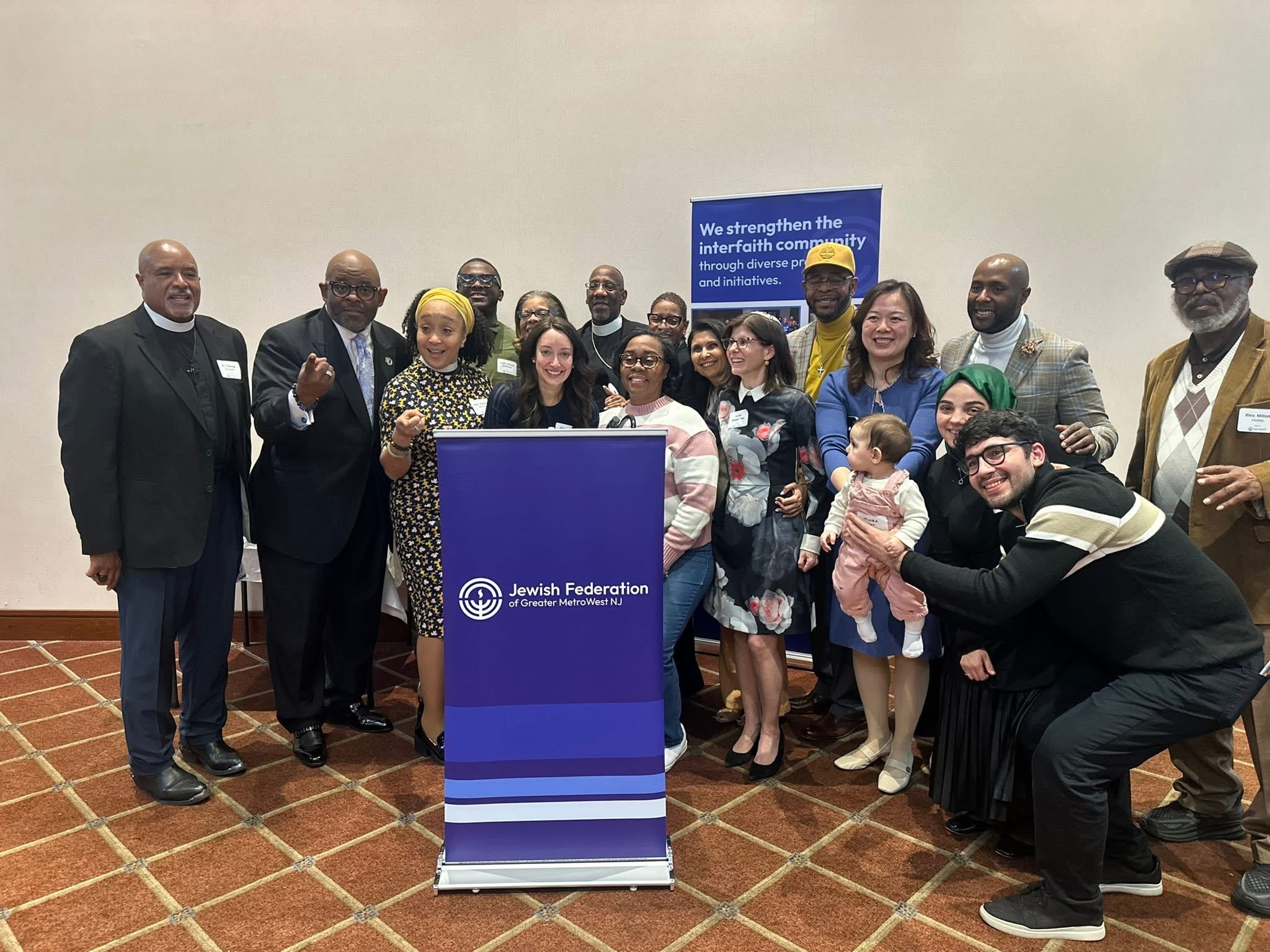
There are moments when a community gathers not only to remember a story, but to live inside its deepest truths. The Interfaith Seder last week was one of those moments.
As Jewish families around the world prepare to tell the story of yetziat mitzrayim—leaving Egypt and moving from narrowness to possibility—JCRC’s Interfaith Clergy Leadership Council welcomed 170 people from across faith traditions, including 18 clergy leaders who carry the spiritual weight and wisdom of their own communities. By design, only three of the clergy were Jewish, and only half the attendees as well. The room felt like a rebuttal to the fragmentation so many of us feel in the wider world: Jews, Muslims, Hindu, Christians of various denominations, sitting side by side, not in debate, not in defense, but in shared curiosity and presence. Three teen leaders—one Jewish, one Christian, one Muslim—were honored for their leadership in Jewish Federation of Greater MetroWest NJ’s Interfaith Teen Leaders program. A Muslim child found the afikomen.
The Passover seder is, at its core, a ritual of memory and imagination. We tell an ancient story, but we are also asked to see ourselves as if we personally went out from Egypt. That “as if” matters. It is an invitation into empathy, into moral imagination, into the ability to locate ourselves in a narrative that is both particular and universal. And when that invitation is extended across lines of difference—when people who do not share the same inherited story nonetheless lean in to hear it, to question it, to find themselves within it—something shifts.
Throughout the evening, we moved through the familiar choreography of the seder: the symbolic foods, the questions, the telling, the songs. As various clergy leaders took their turns leading from a Haggadah created for the occasion, we found ourselves connecting through a shared vision of building community together. In a time when religious identity is so often weaponized, here were religious leaders and laypeople choosing something else: choosing to sit at one another’s tables, to listen carefully, to risk connection. Not because we agree on everything—we do not—but because we understand that the work of building a more just and compassionate world requires relationships strong enough to hold difference.
The rabbis taught that if a family was too small to consume the Passover offering on its own, it should join with a neighbor. This seder felt like a contemporary expression of that ancient impulse to join with neighbors and share our meal and our story.
There is still so much that divides us. That remains real. But for one evening, in one room, we practiced something else: the possibility that sitting together, telling stories, and listening across lines of difference might itself be a form of redemption.
Read more about JCRC’s work in Interfaith Dialogue and Allyship in Washington D.C. by Stephanie Abrahams.