I know it sounds kitsch, but I do believe that our lives are a journey. My life’s journey was impacted greatly from an early age, hearing the stories from my Bubbie and Zaida of their families before 1939 in Poland, their experiences in the concentration camps, and their journey that ultimately took them to Canada, as refugees, where they started a new life.
Helping others has always been the fabric of my family. My Bubbie and Zaida instilled in us the Jewish values of tikkun olam, taking action to repair and improve the world and tzedakah, helping people help themselves as the highest form of social justice and charity. Both demonstrated in individual everyday actions of kindness, as well as in organized ways. It always perplexed me that after the horrors they experienced, they chose this path rather than one of insulation and anger.
My journey participating more actively with Jewish Federation of Greater MetroWest NJ began when we hosted a young woman as part of the Rishonim program. Then a year later my son was part of a terrible antisemitic incident on his travel hockey team. This propelled me to reach out to Federation and I became a volunteer with the Holocaust Education department, accompanying Holocaust survivors to speak of their experiences in public middle schools in NJ and moderating their talks. Next I participated in Federations’s Peoplehood, Living Bridges program forging lasting connections with people in our partner communities in Israel.
Last week I participated in Jewish Federation of Greater MetroWest NJ’s Poland Journey along with 65 community members. It was a rollercoaster of emotions.
The itinerary was brilliantly developed to take us through the vibrant Jewish life pre-war, literally walking in the footsteps of Jews in the small shtetl of Tykocin, as they were forced to live in a ghetto, then taken to the town square, separated into groups of those able to work who were sent to concentration camps, and the other group loaded into trucks and taken a short distance to the forest where they were shot into pits that the men were forced to dig while people with instruments were forced to play music while watching and then being shot into the pits themselves.
We walked along the Ghetto Heroes Trail, the deportation station from where most of Warsaw’s Jews were deported to Treblinka, then saw Treblinka. From Warsaw we drove to Krakow. We went to Auchwitz 1 concentration camp and then to Birkenau death camp.
The rollercoaster of emotions continued as we visited the spark of hope at the Krakow JCC, where they are rebuilding the Jewish community. They now have a pre-school for Jewish children, something I never thought I’d hear. The JCC’s Director shared with us that over the past three years Krakow’s JCC has provided support to Ukranian refugees, today operating a food panty serving 1,000 people a week, mostly women and children, 99% of them not Jewish. To me this is truly exemplary of our Jewish values of tikkun olam. In Poland, the Jews are continuing to help others, as they always have. We ended our journey to Poland together gathering for Havdalah in the main square of Kazimierz and singing Am Israel Chai together.
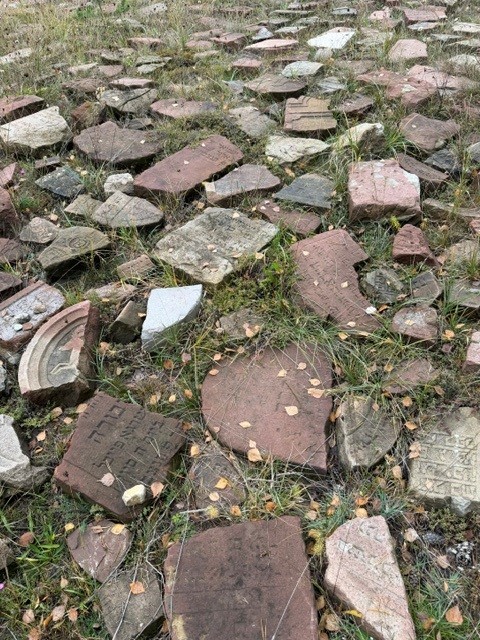
Prior to joining Federation’s Mission to Poland, I only had basic facts of my family’s history and the journey of the mission gave me a broader context and prompted me to dig deeper and ask more questions that resulted in getting more of the richness of our family’s story. On the last day, I visited my grandparents’ shtetls along with a Polish guide. We went to Olkusz, one hour northwest of Krakow where my Bubbie Regina grew up. Prior to December 23, 1939, 4,097 Jews lived in Olkusz. Today, zero. My Bubbie and her two younger sisters were the only ones to survive the war as they were sent to concentration camps. Their four older siblings, their children, my Bubbie’s parents, were all sent to be killed at Auschwitz. I stood in the town square and I could see exactly how my Bubbie described her life before the war. We located the building where her family ran their store and they lived above, we saw the restaurant that her aunt and uncle ran, which is now a jewellery store. We walked outside the town square and saw a plaque on the building commemorating it was a Jewish school, now a town municipal building. We then walked one km to Olkusz’s Jewish cemetery. It was destroyed. Broken headstones and pieces laid out for a path. The Nazi’s removed the headstones and used them to create roads. I stood there, and I said the mourner’s kaddish for all those who died.
From there I went to Strzemieszyce, where my Zaida Shmuel Volv lived with his wife and four children. They were all forced into a ghetto in 1940, and then liquidated in 1942 to be killed in Auchwitz. My Zaida learned that his children and wife were killed through word of mouth as he was in forced labor camps for the years of the war. We could only find one small plaque that commemorated the Jews of Strzemieszyce—no other signs that 2,000 Jews lived there prior to 1939. Our Jewish history totally wiped out.
This takes me to today, back from Poland, back to Morristown, NJ. My current journey is working for the past three years at JVS Metrowest NJ-Jewish Vocational Service, a Community Partner of the Jewish Federation of Greater MetroWest NJ. JVS helps people help themselves through innovative programs in training, education, and career counseling to create pathways to hope, independence, and employment. Inspired by Jewish values, JVS proudly serves clients from any and all backgrounds.
Our roots go back to 1939, when JVS MetroWest NJ was founded to help Jewish immigrants coming to America on the cusp of World War II overcome the barrier of pervasive antisemitism and find financial stability through employment.
Through the years, the people we help and the programs we offer evolved as we reached out to those in greatest need. Over the years, JVS has been at the forefront of responding to the emerging needs of people in our community. Today our goal of helping people find employment and financial stability is the same as it was when we first opened our doors, and has evolved to help all people, regardless of race or ethnicity. We help them overcome barriers related to age, ability, education, immigrant status, job skills training, language, or the effects of generational poverty.
I am so honored and proud to work at JVS, to help people in need, all people, and to never, ever be a bystander.
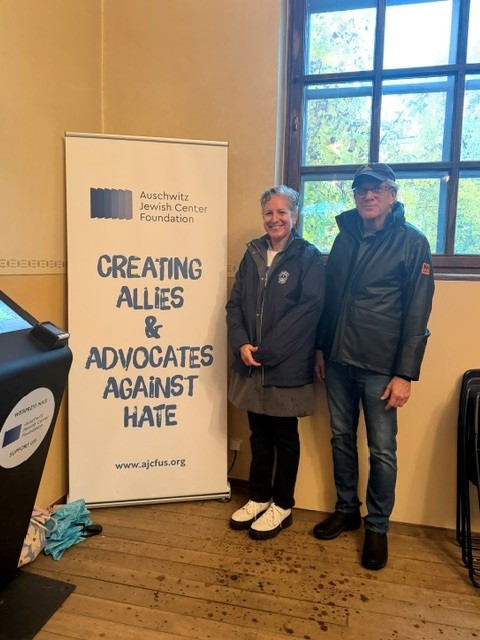
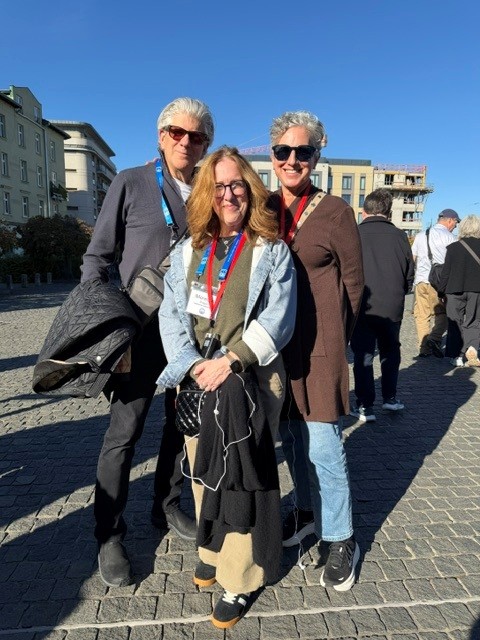
Top photo: left to right: Mark Polson, Board Member, JVS of MetroWest; Meredith Dragon, EVP/CEO, Jewish Federation of Greater MetroWest NJ; and Elisa Udaskin, JVS of MetroWest