

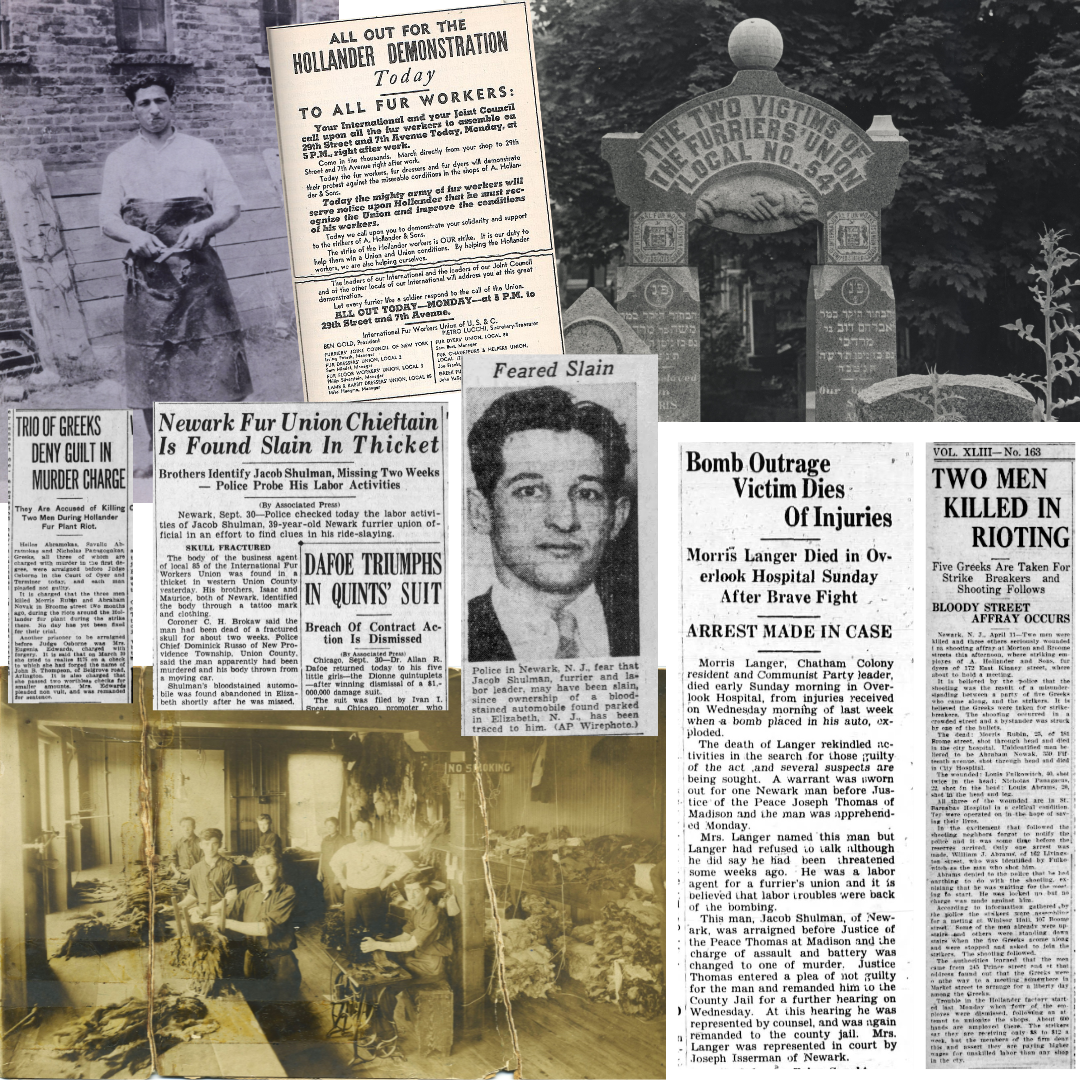
Labor Day is often seen as a holiday of rest and celebration, but its roots lie in struggle, sacrifice, and the pursuit of dignity in work. Newark, New Jersey, with its bustling garment and fur industry, was once the stage of dramatic battles over workers’ rights. Among the stories preserved are those of Jewish immigrants who brought with them not only skills and ambitions, but also a fierce commitment to justice and solidarity.
In 1889, Albert Hollander, an immigrant from Poland, arrived in America with little more than his knowledge of the fur trade. He soon founded A. Hollander and Sons Fur Care Limited, anchoring his business in Newark’s garment district. The Hollander family prided themselves on excellence, developing a patented fur-cleaning process in 1918—“Hollanderizing”—that became so renowned it was even referenced in Broadway’s Guys and Dolls. By the 1920s, Hollander’s factory on East Kinney Street had grown into the largest fur processing plant in the world, employing nearly 5,000 workers.
Yet behind this success were workers—many of them Jewish and Italian immigrants—laboring long hours under harsh conditions. For them, the promise of America was incomplete without fairness in the workplace. Newark’s fur industry soon became a battleground where questions of justice, exploitation, and solidarity were fought not only in shops but also in the streets.
One such figure was Morris Langer, who began working at Hollander at age 15. By 1920, he had risen to vice president of Local 25 of the International Fur Workers Union, a union with strong Jewish leadership and membership. When workers launched a strike in February 1933 to demand fairer conditions, Langer emerged as a leader. That strike ended in bloodshed. On March 27, 1933, Langer was killed in a car bombing—his murder tied to racketeering and corruption in the fur trade. His funeral drew thousands. Three thousand workers marched through Newark, while 4,000 gathered in Military Park, honoring him as a martyred defender of labor.
Langer’s death echoed earlier tragedies. In 1915, during another strike at Hollander’s, fur workers Abraham Novak and Morris Rubin were gunned down. Both were buried in the Workmen’s Circle section of Grove Street Cemetery, beneath a monument inscribed with their defiant words: “We must have a union; conditions in the shop are unbearable.” The choice of burial in the Workmen’s Circle—an organization deeply tied to Jewish immigrant life and the ideals of justice, culture, and community—underscored the intersection of Jewish identity and the labor movement.
Even beyond Langer, Novak, and Rubin, the violence continued. Jacob “Jack” Shulman, a delegate for the Furrier’s Union, disappeared after leaving a union meeting in September 1933. His abandoned car was discovered, and soon after, his murdered body—a chilling reminder of the risks faced by those who challenged powerful interests.
These stories of Newark’s Jewish furriers reflect the broader Jewish immigrant experience in America: building new lives, striving for economic security, and fighting for justice not only for themselves but for all workers. The values of community solidarity, fairness, and human dignity—rooted in Jewish tradition—animated much of this activism.
On Labor Day, we remember not just a holiday but a history. Newark’s furriers, many of them Jewish immigrants, remind us that the rights we now take for granted—shorter workweeks, safer workplaces, and the right to organize—came at a heavy cost. Their struggle is part of both Newark’s legacy and the Jewish American story, one of resilience, sacrifice, and an unshakable belief in justice.
Archival material courtesy of the Warren Grover collection.