
The women’s suffrage movement in the United States was a determined, decades-long struggle to secure women the right to vote and shape the nation’s future. It began gaining momentum in the mid-1800s, rising alongside other major social movements such as the fight to end slavery.
Jewish women were often at the forefront of this push for change, lending their voices, organizing skills, and reform-minded ideals to the cause. Many were already deeply involved in progressive efforts advocating for labor rights, aiding immigrants, and championing education reform which naturally aligned with the fight for women’s enfranchisement.
In Newark, Jewish suffragists marched in parades, delivered speeches, and built alliances with other suffrage groups and labor unions. Their activism not only contributed to the passage of the 19th Amendment in 1920 but also connected the fight for voting rights to broader struggles for equality, fair labor practices, and social welfare.
Among Newark’s prominent suffrage advocates were Elizabeth Blume Silverstein, Florence Haines, Florence Peshine Eagleton, and Violet Johnsonson and numerous others. Alongside these pillars stood Augusta Parsonnet.
Born in Poland in 1870, Augusta immigrated with her family to Newark in 1886. A gifted student, she met Victor Parsonnet, a fellow Jewish immigrant from Ukraine who had fled anti-Jewish pogroms. The couple married and ambitiously pursued medical careers. Augusta attended Tufts Medical School and Victor at Bellevue Medical School. In 1897, she enrolled at the Women’s Medical School of the New York Infirmary for Women and Children, but financial hardship forced her to leave and help support Victor by working as a seamstress in the Singer factory.
In 1901, Victor co-founded Newark Beth Israel Hospital with Max Danzis, and Augusta became president of the hospital’s Ladies Guild. Under her leadership, the Guild became a powerhouse of support, fundraising for essential equipment, furnishing the nurses’ home and maternity ward, and ensuring ongoing resources for patient care. Its mission was clear: to provide a steady source of income for the hospital, a goal achieved through relentless community engagement.
Beyond her hospital work, Augusta was driven by a passion for social reform, with women’s suffrage at the forefront. She helped establish the Newark-based Women’s Political Union (WPU) of New Jersey and served first as vice president, then president from 1916 to 1917. She campaigned tirelessly for the unsuccessful 1915 New Jersey Suffrage Referendum, the victorious 1917 Referendum, and ultimately for New Jersey’s ratification of the 19th Amendment in 1920.
By 1927, Augusta’s leadership extended even further as she became the first president of both the Newark League of Women Voters and the Newark Council of Jewish Women. For Augusta, the fight did not end with the ballot box. Equal rights, she argued, were meaningless unless women took equal leadership alongside men.
Augusta Parsonnet lived in the Weequahic section of Newark and later with her son Eugene and his family in the city’s Lincoln Park neighborhood. She died there on November 18, 1949, at the age of 79. Her legacy endures in the institutions she helped build, the movements she led, and the generations of women whose voices she helped to empower.
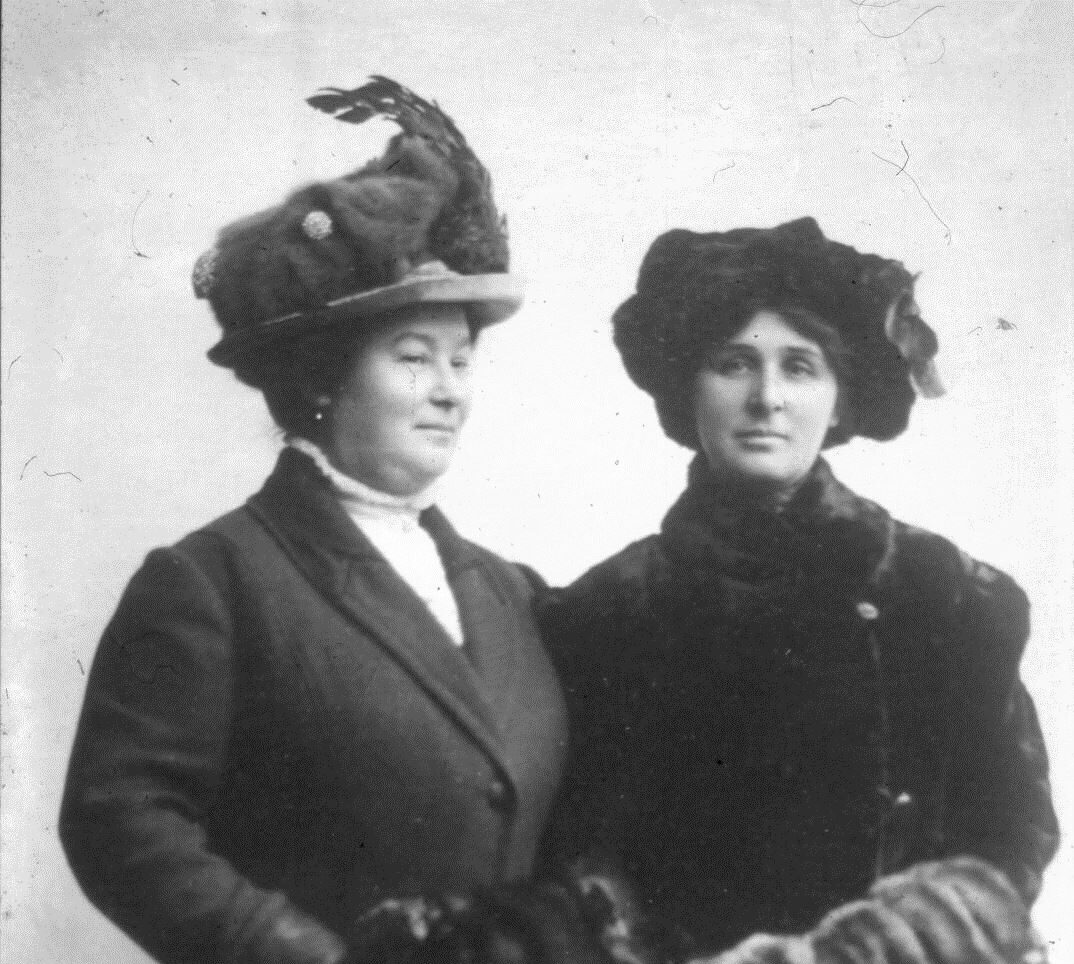
Photo courtesy of the Jewish Historical Society Archives: Augusta Parsonnet (left) with Jennie Danzis.