
May is Jewish American Heritage Month (JAHM)—a time to reflect on the rich cultural, historical, and societal contributions of Jewish Americans. Established in 2006, this observance recognizes the vital role Jewish communities have played in shaping the cultural, social, and economic landscape of the United States.
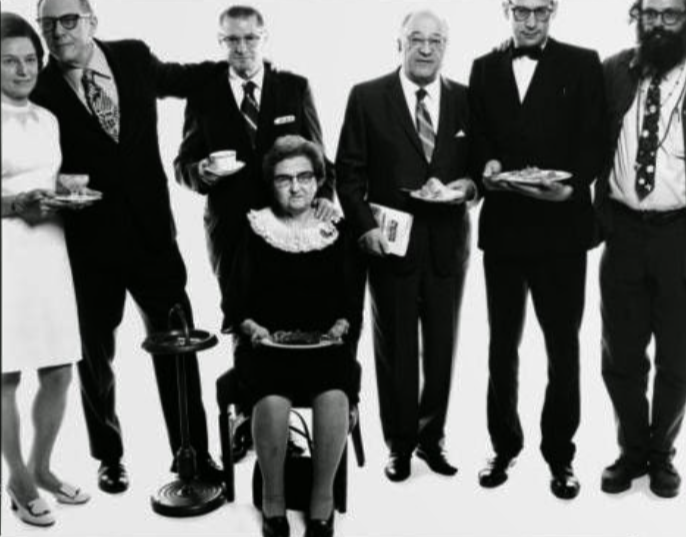
Hannah and Leo Litzky (far left) with members
of the Ginsberg/Brooks families, 1970
Here in Greater MetroWest New Jersey, our community has been shaped and strengthened by many whose legacies continue to inspire. This month, we proudly honor three such individuals: Michael Stavisky, Dr. S. William Kalb, and Hannah Litzky.
Michael Stavisky (1895-1967)
Michael Stavisky was more than a community leader—he was a cornerstone in the development of Jewish communal life in Newark and the surrounding areas. He moved to the United States from Russia at the age of eight. He earned an accounting degree then a master’s in social work from NYU. In 1922, his career shifted from social work to business, mostly real estate and mortgage financing. This gave him the ability to deal with both financial and social issues as they emerged in the Jewish community.
He was chairman of Newark’s United Jewish Appeal, president of the Jewish Education Association and President of Temple B’nai Abraham, where he was responsible for bringing Rabbi Joachim Prinz to the congregation. His early life was shaped by a strong emphasis on education, which laid the groundwork for his advocacy in educational reform, particularly for underserved communities. As president of the Conference of Jewish Charities (Now Jewish Federation of Greater MetroWest) he presided in the immediate post-Depression era, one of its most critical periods.
Stavitsky’s dedication to Jewish life and service elevated him to national stature. He played influential roles in major organizations, including the World Federation of YMHAs, the United Synagogue Council of America, and the National Jewish Welfare Board’s Committee Funds. His passion for education and community health also led him to serve on the prestigious National Committee of Sponsors for the Albert Einstein College of Medicine at Yeshiva University.
In a 2012 article in the New Jersey Jewish News, it is written that in Rabbi Prinz’s eulogy of Stavisky he states: “The life of Mike Stavitsky was a very extraordinary life,” said the rabbi. “He became the father of the Jewish community in Essex County, for the motto of his life was ‘either community or death.’”
Dr. S. William Kalb (1897-unknown)
Born in Newark, New Jersey in 1897, S. William Kalb demonstrated a commitment to service early in life. Shortly after graduating from high school, he enlisted in the U.S. Marine Corps and served in Europe during World War I. Upon his return, he pursued higher education at Valparaiso University, where he earned a degree in pharmacy. He then continued his academic journey at the University of Cincinnati’s Medical School, receiving his M.D. in 1925.
In 1931, Kalb returned to his hometown of Newark to begin building his medical practice. Alongside his professional career, he became deeply involved in Jewish communal life. He was a founding member of Post 34 of the Jewish War Veterans, serving not only as the organization’s official physician but also as a leading advocate in the fight against antisemitism.
As leader of the Non-Sectarian Anti-Nazi League (NSANL), Dr. Kalb emerged as a central figure in the resistance to Nazi influence in the United States. He spearheaded efforts to organize boycotts of German imports, directing pressure at department stores in New Jersey and New York that continued to carry Nazi-produced goods. A passionate advocate for justice, Kalb used his position as President of the American Federation of Labor to rally the labor movement behind the cause. At a 1933 American Jewish Congress rally, he delivered a powerful public denunciation of Nazism, citing its brutal suppression of both labor and Jewish communities. Through tireless collaboration with union officials and Jewish organizations, Kalb helped build a broad coalition that extended far beyond Newark—galvanizing regional support in an urgent stand against the spread of fascist ideology.
Hannah Litzky (1913-1999)
Hannah Litzky had a distinguished career at Weequahic High School, where she served as both an English teacher and guidance counselor from 1934 to 1973. During her 39 years at WHS, she significantly impacted the lives of many students and contributed to the educational environment by fostering a sense of community and belonging among her students of the Weequahic community. Her dedication to her students was evident in her approach to teaching and guidance.
She earned her bachelor’s degree from Montclair State, which laid the foundation for her career in education. She continued her education and earned her master’s degree at New York University in New York City and spent a year in graduate study at Oxford University, England. Active with the American Jewish Congress, she served two terms as president of the Business and Professional Women’s chapter. She also belonged to Temple B’nai Abraham, Livingston, and was active with Amnesty International, NOW, Common Cause and the Sierra Club.
As a guidance counselor, she played a crucial role in supporting students through their academic journeys and personal challenges, fostering an atmosphere of growth and opportunity. In recognition of her contributions, alumni from Weequahic High School have established a memorial in her honor, demonstrating the lasting influence she had on her students and the school as a whole
Litzky’s commitment to education was evident in her innovative teaching methods and her ability to connect with students. She championed a curriculum that emphasized not only academic rigor but also the importance of personal growth and ethical development. Her approach resonated with students, many of whom credit her with inspiring their own educational journeys.
Beyond her classroom duties, Litzky was actively involved in various school initiatives and community programs. She organized events that brought together students, parents, and faculty, reinforcing the importance of collaboration and mutual support within the school community. Her efforts in creating a supportive environment helped cultivate a culture of respect and inclusivity at Weequahic. Hannah joined the Newark Teacher’s Union Local 481 in 1936 and the Weequahic section of the South Ward of Newark became the Union’s unofficial headquarters. Litzky along with other colleagues were committed to fighting for the rights of both teachers and students. They helped shape the vision of what education would be: demands for smaller classes, insistence that teachers be paid to attend after-school activities and they also insisted that Newark develop a citywide food program for needy children.
Hannah Litzky’s legacy endures not only through the countless students she taught but also through the principles she instilled in them. Her belief in the transformative power of education and her unwavering dedication to her students have left an indelible mark on the Weequahic community. Many former students recount their experiences, and the lasting lessons learned from Litzky, reflecting her significant role in their personal and professional successes.
Looking Back to Move Forward
As we mark Jewish American Heritage Month, we reflect not only on the history of the Jewish people but on the lives of individuals who dedicated themselves to building and enriching Jewish life here in New Jersey. Michael Stavisky, S. William Kalb, and Hannah Litzky were committed to Jewish causes because of their Jewish values—and they lived those values every day. They remind us that a community is built through vision, courage, and heart.
Each of them was driven by a deep commitment to Jewish values—values that teach us to care for one another, to pursue justice, and to build strong, inclusive communities. Their work wasn’t just about programs and institutions—it was about people. Then and now, these values bring us together to lift one another up and ensure no one is left behind.
For information or to see these or our other collections, contact Jill Hershorin at 973-929-2995 or [email protected]