

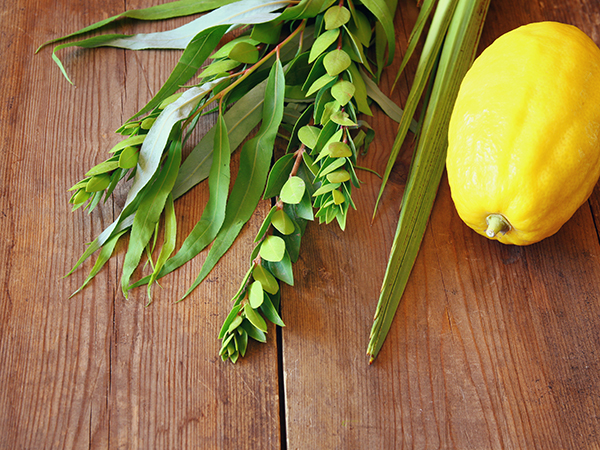
Sukkot is my favorite Jewish holiday. I love spending time in the sukkah. Being outdoors, gathering with family and friends to eat and sing and celebrate. So much fun. In the synagogue, gathering together the lulav and etrog, shaking them in all directions and joining the community as we parade around the room. It can all feel a little silly, in a way that makes me smile just thinking about it.
I don’t use the word “silly” in a belittling way. I mean it as something that touches my sense of humor and happiness and makes me feel great. From its biblical beginnings, sukkot was a holiday meant to elicit feelings of joy. In Deuteronomy, chapter 16, sukkot is described as a fall harvest festival, that when the Israelites celebrate it, they “shall have nothing but joy” (verse 15). Rabbinic tradition echoes this and refers to sukkot as zeman simchateynu, the season of our joy.
So, I was struck when I saw that this year the first day of sukkot (always on the 15th of Tishrei on the Jewish calendar) will fall on October 7, the second anniversary of the deadly attack against Israel. This confluence of a joyous holiday with such a sad memorial on the same day has left me wondering, how am I going to hold all of that emotion together at once? How will I be able to feel happy about circling the synagogue with my lulav and etrog, while remembering that so many Israelis weren’t able to circle the synagogue, or even make it to synagogue, on simchat torah of October 7, 2023? How will I sing the uplifting psalms of praise in the hallel service, when I want to recite poems of lament?
We Jews have a long history of traumatic events, and wisdom in our heritage from the ways our ancestors grappled with similar questions. In the Babylonian Talmud there is a powerful section about how Jews dealt emotionally after the destruction of the second Temple in 70 C.E. In Tractate Bava Kama, page 60b, we read that after the destruction of Temple there was an increase in the number of ascetics, people who denied themselves pleasures, such as eating meat and drinking wine, as a daily reminder of the loss of the sacrificial rituals of the Temple. Rabbi Yehoshua, a prominent rabbi of that time, points out that this sort of self-denial becomes dangerous when taken to its logical extreme. He asks, since in the temple there were water libations, should mourners deny themselves water? Of course, we can’t live without water, and we also can’t live without joy.
Rabbi Yehoshua offers a balanced approach, stating that “To not mourn at all is impossible, as the decree was already issued and the Temple has been destroyed. But to mourn excessively is also impossible.” And he offers examples of how to do this. For example, the rabbis teach that when plastering the walls of one’s home we should leave a small section without plaster, as a reminder of the destruction of the Temple. In this way, we build our lives, beautiful homes that make us feel safe and happy, and also include a symbol of sadness. This same idea is expressed at traditional Jewish weddings, where a glass is broken as symbol of sadness, for the destruction of the Temple or the many broken things in our world, in the middle of the very happy moment of consecrating a new marriage.
As I approach this coming sukkot on October 7, I am not sure how I am going to feel. I can try to lean on the wisdom and lived experience of Rabbi Yehoshua, to not mourn excessively and to enjoy the happy feelings of the holiday. But I am not sure I will succeed. Will the memories of October 7 end up being a small patch on the wall of my day? Or will I feel like those ascetics in the Talmud, reminded by everything I see of our people’s loss and trauma?
Either way, knowing that Jewish tradition acknowledges and ritualizes how we think about these complicated feelings encourages me to keep grappling with them myself. The war in Israel goes on and the people of Israel are traumatized. And yet, the Jewish people live on, with our daily joys and annual community celebrations. It seems to me that the sadness and the happiness of our lives often mix together, albeit not usually in as stark a way as this coming sukkot on October 7. I pray for times ahead when our sadness is more easily pushed to a small patch of our metaphorical walls, when we are safe from harm and recovered from trauma, and can turn our emotional attention more fully to simcha, joy.
Find meaningful ways to honor the memory of October 7 and stand in solidarity with Israel and the Jewish community. Explore our dedicated Marking October 7 webpage for resources, support, and opportunities to connect.