

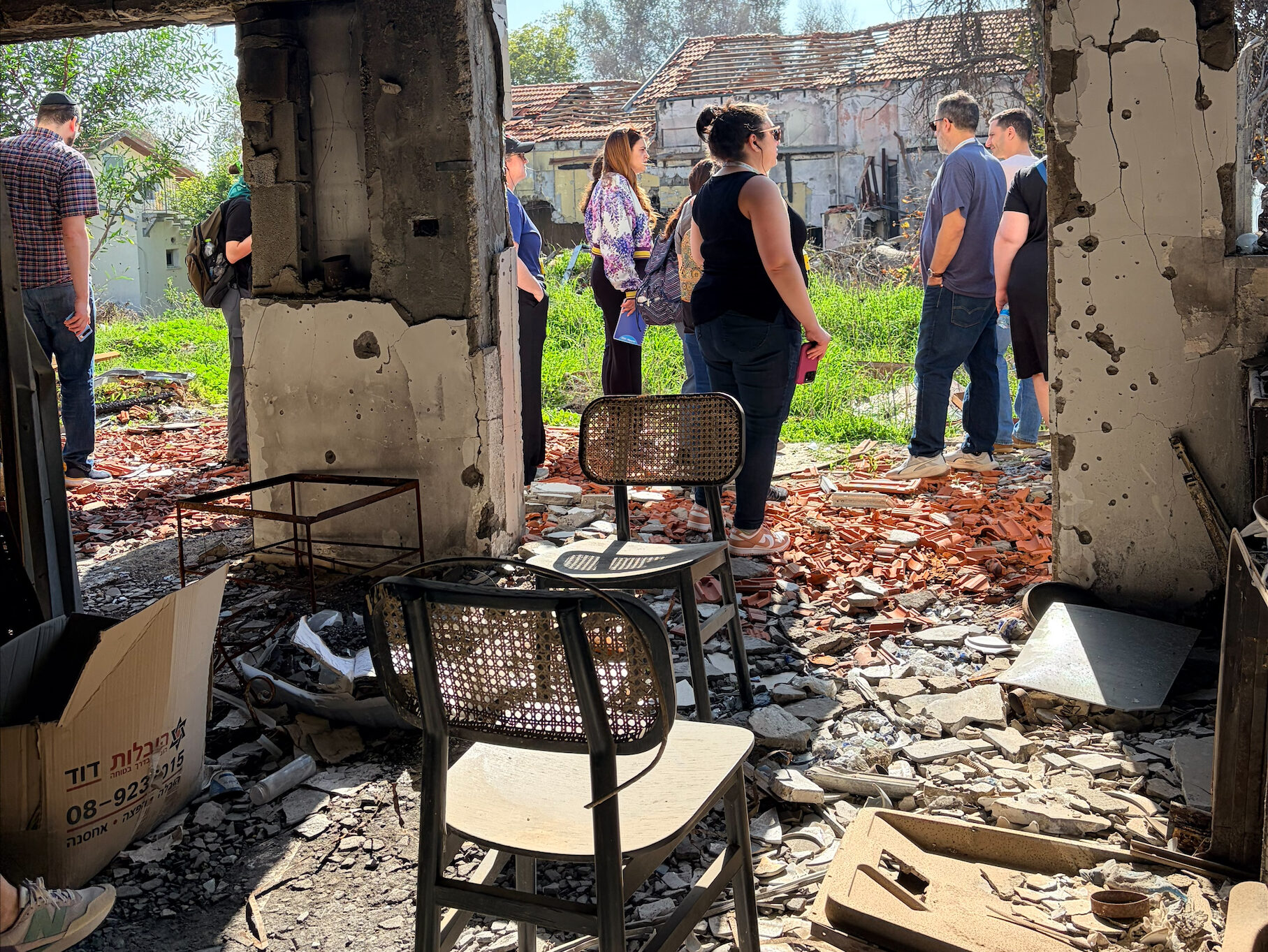
The Hebrew word sipurim means “stories.” The premise of the Sipurim trip to Israel I recently took with Hillel International, alongside 54 other Hillel professionals, was simple: to listen. Not to debate, fix, or explain Israel to the world or even to ourselves, but to hear directly from people across the country about what happened to them and their loved ones, and what life has been like since October 7.
I returned home with many new thoughts, but what stayed with me most was the idea of gam v’gam: this and also this. Holding two truths at the same time. What we heard from our travels were grief and hope, love of country and deep distrust of its leadership, trauma and resilience, and rage and responsibility. None of these cancel the other out.
Over six days, from the Gaza envelope to Israel’s northernmost border, we met people whose lives have been irrevocably changed. Nearly everyone we encountered was still actively grieving. October 7 has not been fully processed or put behind anyone… it is present, raw, and unfinished. And yet, in almost every conversation, hope appeared too. Not naïve optimism, but stubborn, hard-earned hope.
Even the walls of Tel Aviv told this story. Post–October 7 graffiti is everywhere, layered, altered, and evolving. Faces of hostages stare out from concrete walls. Hopeful slogans are written and images are painted, crossed out, amended, defaced, and rewritten. Murals honor fallen soldiers, first responders, and festival-goers. Some images scream in rage, while others whisper in grief. The graffiti feels like a living archive of the war: public grief, public memory, and resistance to forgetting. Gam v’gam in visual form; memorial and protest, despair and love for this place, side by side.
On our first day, we heard from Jon and Rachel Goldberg-Polin, whose strength feels both superhuman and heartbreakingly human. Rachel, whose son Hersh was murdered while in Hamas captivity, said, “There’s hope and positivity everywhere… but we’re also a broken people. We can be really not okay, and broken, and sad—and that is sacred.” Their ability to hold two truths is evident in the advocacy work they continue every day, even as they call for accountability for the most devastating loss of their lives.
This theme echoed throughout the trip. We heard from Rabbi Doron Perez, President of the World Zionist Organization, who is carrying both national responsibility and personal grief after the death of his son. From Gadi Elias, a chef who cooked tens of thousands of meals for soldiers, feeding morale as much as bodies. From a released hostage who was working security at the Nova festival when he was taken and now shares his story with light and generosity. From Shlomi Sofer of Netivot, who built an emergency plan for his city, and then had to activate it as 22 friends and family members were killed. From Nili of Kibbutz Be’eri, who witnessed the massacre of her community and chose to return home as an act of resilience.
And then there was Majdel Shams.
Majdel Shams is a Druze town in the Golan Heights, near the Syrian border, where many residents have family just across the line. In July 2024, a missile attack killed 12 Druze children on a soccer field there on a sunny Saturday morning. Twelve children whose families had nothing to do with Hamas, Israeli politics, or this war. Children killed simply because they live in Israel. We met two teenage girls who lost younger siblings in that attack. They spoke clearly and powerfully, without theatrics or curated anger. Their grief was devastating, and yet they spoke about their futures, about dignity, safety, and preserving their brothers’ memories. Most strikingly, they were gracious hosts. While mourning unimaginable loss, they offered us tea, coffee, dates, and sweets, and thanked us for coming to hear their stories. Once again: gam v’gam.
The Druze community occupies a complex space in Israel. They are deeply loyal to the state, with most young men serving in the military, while maintaining a distinct religious and cultural identity. What stood out in Majdel Shams was how little interest there was in being used as a symbol or talking point. They weren’t there to prove anything. They wanted to be seen as part of the Israeli family, and to mourn children who should still be alive.
Across the country, one truth was nearly universal: profound distrust in the Israeli government. Jewish, Arab, and Druze Israelis all said it. People feel angry, abandoned, and failed… on October 7 and since. And still, gam v’gam, they hold onto hope. That hope isn’t coming from politicians. It’s coming from one another. From neighbors cooking meals, strangers opening their homes, and volunteers filling the gaps leadership has left behind. From people showing up not because they agree on everything, but because this war has touched everyone.
This is not a war that has only affected Jewish Zionists. That narrative collapses the moment you listen. Sirens don’t discriminate, and missiles don’t check religion. Grief doesn’t ask how you vote. What I saw in Israel was not sameness, but solidarity, and a shared understanding that whatever your politics or faith, you are bound together by reality, by loss, by fear, and by responsibility for one another.
Gam v’gam is uncomfortable. It doesn’t fit neatly into social media posts or talking points. It asks us to hold pain without rushing to resolve it, and hope without demanding certainty.
Why This Matters for Our Hillel Community
For our Hillel community, gam v’gam isn’t just a concept… it’s a necessity.
Our students are holding multiple truths every day: love for Israel and deep frustration with its leadership; connection and alienation; pride and pain; fear for family and friends alongside questions about what comes next. What this trip reaffirmed for me is that Hillel must remain a place where complexity is not just allowed, but honored. If Israelis across religion, ethnicity, and ideology can grieve together, argue fiercely, distrust their government, and still show up for one another, then our Hillel spaces can do the same. We don’t need our students to simplify their feelings to belong. We need to give them room to tell their stories, to listen to others deeply, and to hold this and also this at the same time.
That, ultimately, is what Sipurim taught me: stories don’t resolve tension. They teach us how to live inside it, together.