

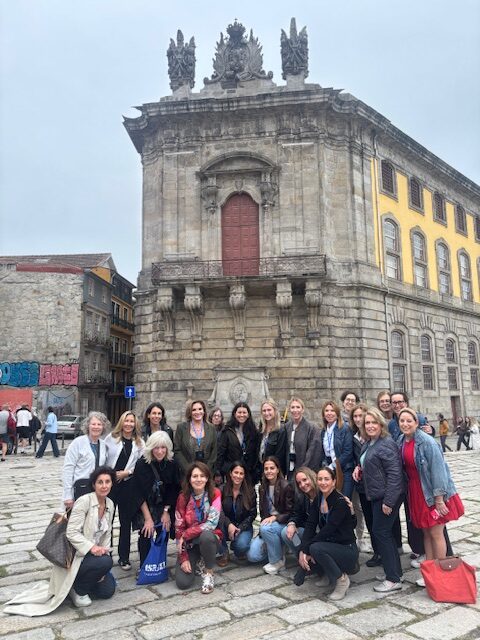
This was my first Federation mission after October 7, and it felt different from any trip I’ve ever taken. Beyond the travel, it was an opportunity to connect with other women in our community, to hear their stories, and to grow closer across generations and geography. I had met some of the participants before at meetings, but many were new faces. Walking through cobblestone streets, sharing meals, and talking late into the evenings, I felt real connections forming.
Our tour guide in Portugal was incredible—serious, intense, and deeply knowledgeable. She wasn’t Jewish, but she had devoted her life to studying Portugal’s Jewish history. She didn’t shy away from the difficult parts, and she brought the past vividly to life. I learned that Jews have lived in Portugal since Roman times. By the Middle Ages, one in five people in the country was Jewish, contributing richly to commerce, culture, and society.
In 1497, King Manuel I issued an edict forcing all Jews to either convert to Christianity or leave the country. Synagogues were confiscated, and those who converted—known as Marranos or New Christians—had to practice their faith in secret. The establishment of the Portuguese Inquisition in 1536 made life even more precarious, as even converted families could be persecuted for secretly maintaining Jewish rituals.
Many Jews fled, and those who remained had to adapt to survive. I was struck hearing that our guide’s own grandmother covered mirrors during periods of mourning and observed rituals every Friday afternoon. It made the history feel deeply personal, a reminder of the resilience that allowed Jewish life to endure, even in the shadows.
In Porto, we visited HaMakom—“The Place”—a progressive Jewish community working to reignite Jewish life in the city. It was inspiring to see how a small group of committed people, including two female rabbis, is building services, events, and connections that give the community a new sense of vitality.
On our way from Porto to Lisbon, we stopped in the historic, sun dappled town of Tomar to explore one of Portugal’s oldest preserved synagogues, the Synagogue of Tomar. Built between 1430 and 1460 and named after the Jewish astronomer Abraham Zacuto, it was a place of worship until 1496, when the Jews were expelled from Portugal. The synagogue was later repurposed for other uses, but it has since been restored and now houses the Abraham Zacuto Portuguese Jewish Museum.
What I remember most is the mikvah (ritual bathhouse), now protected behind a glass wall. Standing on the other side, I looked down and could see the remains of where generations of Jews once ritually immersed themselves, a place of private devotion and continuity, even as public Jewish life was forcibly erased.
In Lisbon, we visited another Synagogue, Shaaré Tikvah. Outside, a magnificent pomegranate tree stood in the courtyard, where nearby bricks were engraved with the names of community leaders, presidents of the shul, politicians, and others who helped sustain Jewish life here.
Of course, the trip wasn’t all history lessons.
I loved making warm pastel de nata, laughing and dancing with my fellow travelers, and wandering through Porto’s Bolhão Market, where artisans create jewelry and textiles by hand.
From castles and Jewish quarters in Lisbon, with their wrought-iron gates and stone streets, I saw the continuity of Jewish life in every preserved artifact, every story, every person working to maintain these communities. It reminded me of why Federation’s work matters: supporting, sustaining, and connecting Jewish life wherever it exists. As one leader on the trip said, “No one else is going to continue Jewish life for us. If we stop, it won’t exist anymore. It’s up to us to make sure it thrives.”